
বন্ধুই যখন শত্রু

যা জানা জরুরি
- Wandering through the same forest, sitting side by side to clean each other's dirt, standing by each other in times of danger - this…
- Competition for food, territory, and reproductive opportunities are all possible explanations. But food scarcity alone cannot explain this conflict. The discussion in 'Science' mentions…
- Which members have weakened communication between factions?
বিস্তারিত প্রতিবেদন
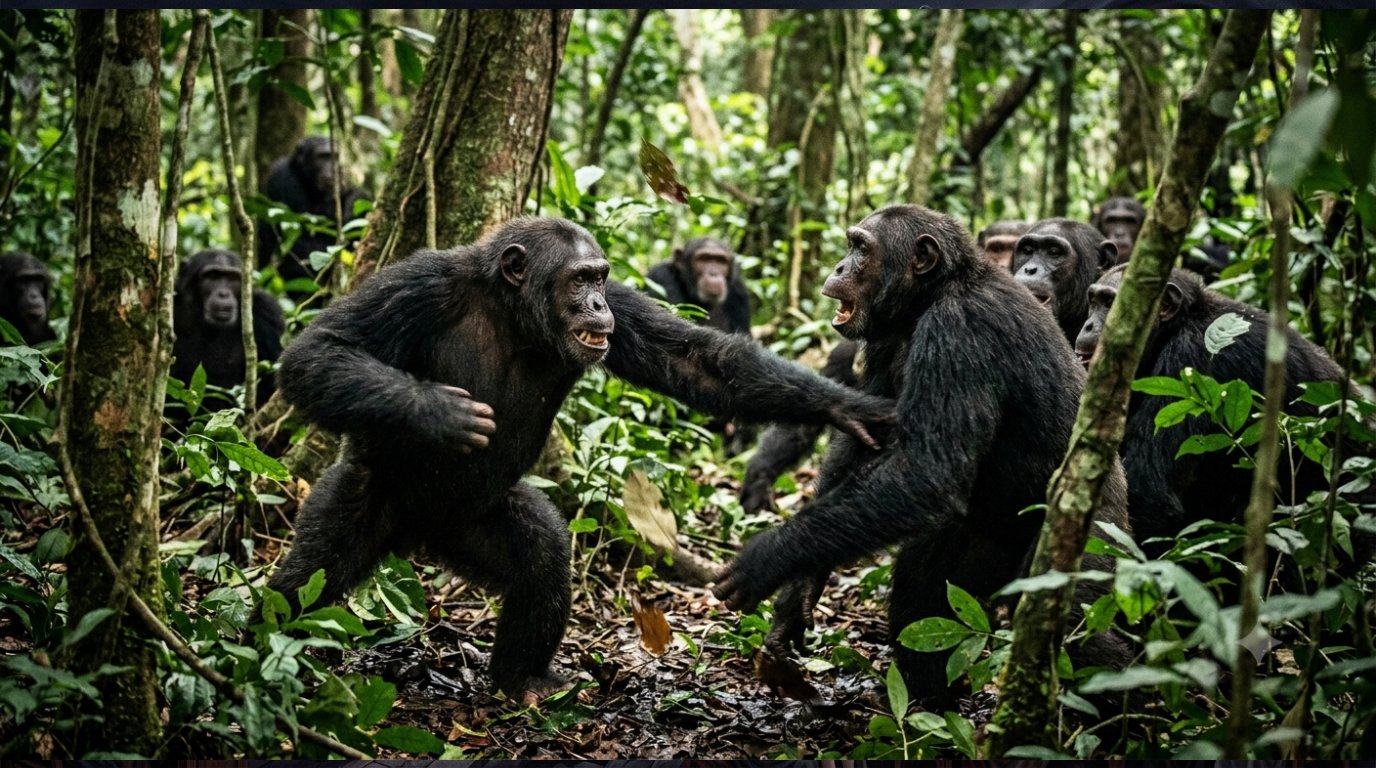
Wandering through the same forest, sitting side by side to clean each other’s dirt, standing by each other in times of danger – this was once their life. Now those familiar companions are each other’s adversaries. In the Ngogo region of Uganda’s Kibale National Park, a large social group of chimpanzees has split into two opposing factions. The long conflict has included gang attacks, ambushes, injuries and deaths. Although comparisons have been made to human ‘civil wars’, researchers are wary of using the term.
The incident came up in a discussion in the Hindustan Times. Since the full text of the related report is not readily available, a picture of the incident can be obtained by combining the information provided with published research and statements of researchers.
There was a society for two decades.
Regular studies of the Ngogo chimpanzees began in 1995. For nearly two decades, researchers had observed a relatively cohesive society. There were small factions, of course, but the divisions were flexible. Members moved from one group to another and reunited. Even when they separated to search for food, the larger social ties remained intact.
That is, being members of the same society did not mean always staying together. Rather, they maintained ties with the larger group, even if they changed sides as needed.
Then, in 2015, a shift began to occur. Members of the western and central groups began to avoid each other. At the same time, the balance of power among males shifted. The previous year, several adult male chimpanzees had died. Researchers believe that some of these members played an important role in maintaining communication between different groups.
In their absence, that social bridge may have weakened. However, no single death or change of leadership has been identified as the definitive cause of this division.
Breakdown complete in 2018
By 2018, the split was virtually complete. The western group had 83 chimpanzees and the central group had 107. Not only did the groups separate, but their habitats also diverged.
The relationships that once provided security are gradually replaced by new group memberships. Years of familiarity seem to lose their importance in the face of new social boundaries.
After that, a more terrifying chapter began.
The attack is not just isolated.
The most worrying aspect of the conflict is its organized nature. Researcher Aaron Sandel told Reuters that the attacks involved violent behavior such as biting, hitting, dragging and kicking. The attacks were mainly carried out by adult males, although adult female chimpanzees sometimes joined in.
The April 2026 report mentions at least 28 deaths. The dead included adult men as well as children. The western group was in the lead in the series of attacks.
Therefore, viewing the incident as a ‘war’ between two equally powerful groups may lose the picture of the actual unequal violence.
There was food, but still conflict.
Why is this happening? Competition for food, territory, and reproductive opportunities are all possible explanations. But food scarcity alone cannot explain this conflict.
The discussion in ‘Science’ mentions that there was enough food in the Ngogo region at that time. In other words, the simple equation that wealth will ensure social peace is not working here.
Rather, researchers are looking at social relationships. Who has lost contact with whom? Which members have weakened communication between factions? Which relationships have broken down and replaced old cooperation with distrust?
These questions may be the key to understanding the deeper causes of the conflict.
Even the enemy was once your own.
The significance of this event cannot be measured solely by the number of deaths. The behavior of the chimpanzees of Ngogo is a rare example of how long-standing acquaintances can turn into enmity.
From the outside, they are two different groups. But researchers know that they had a common past. The animal that is now targeted as a member of another group once roamed, rested, or cooperated with it in the same area.
That is, the hostility developed not between complete strangers—but between animals that shared the same social history.
From the forest to the screen
The life of this community has been brought to a wider audience by Netflix’s four-part documentary series ‘Chimp Empire’ . Released in 2023, the documentary, directed by James Reed and narrated by Mahershala Ali, explores the lives of Ngogo’s chimpanzees, including leadership struggles, personal relationships, and child rearing.
The individual’s position within the larger social conflict is also shown through familiar characters like Jackson and Miles, as well as the central and western groups.
But behind the few minutes of confrontation on screen was a long wait on the ground. According to the filmmakers, they had to wait for months, following the movements of the two groups. In moments of tension, the chimpanzees quickly moved into the forest. Finally, after the members of the West entered the central area, it was possible to capture the scene of the resistance.
Not a human ‘civil war’
Given the drama of the documentary or the intensity of the conflict, it would be wrong to think of this chimpanzee struggle as a direct equivalent to a human political or military ‘civil war’. Chimpanzee group conflict is not like human states, ideologies, institutions, or political power structures.
Yet the Ngogo incident raises an important question: How permanent are the social relationships that seem permanent today?
Researchers are seeking answers to difficult questions in the dense forests of Uganda: how cooperation is formed, what relationships sustain it, and under what circumstances can that relationship break down and turn into hostility.
What once cleaned up each other’s messes is now a deadly conflict. This uncomfortable scene in nature may remind us that while cooperation is natural, its breakdown is just as real.
সূত্র ও সম্পাদকীয় নোট
প্রতিবেদনের তথ্য প্রকাশের আগে সংশ্লিষ্ট উৎস ও প্রাসঙ্গিক নথি যাচাই করা হয়েছে। নতুন তথ্য পাওয়া গেলে প্রতিবেদনটি আপডেট করা হতে পারে।

বাংলাস্ফিয়ার ডেস্ক
বিশ্বস্ত উৎস যাচাই করে পাঠকের জন্য সংবাদ ও ব্যাখ্যা প্রস্তুত করে বাংলাSphere সম্পাদকীয় দল।
আরও লেখা →